In power semiconductors, such as IGBTs and diodes, the copper bridges connecting the silicon core to the external terminals perform a critical role in electrical and thermal conduction. However, these same bridges can become a weak spot of the system if subjected to cyclic thermal stress.
One of the most common causes of failure in these types of devices is thermal fatigue of the bridges, which over time can lead to their breakage and significantly shorten the component’s lifespan.
Thermal fatigue: the result of the thermal switching cycle
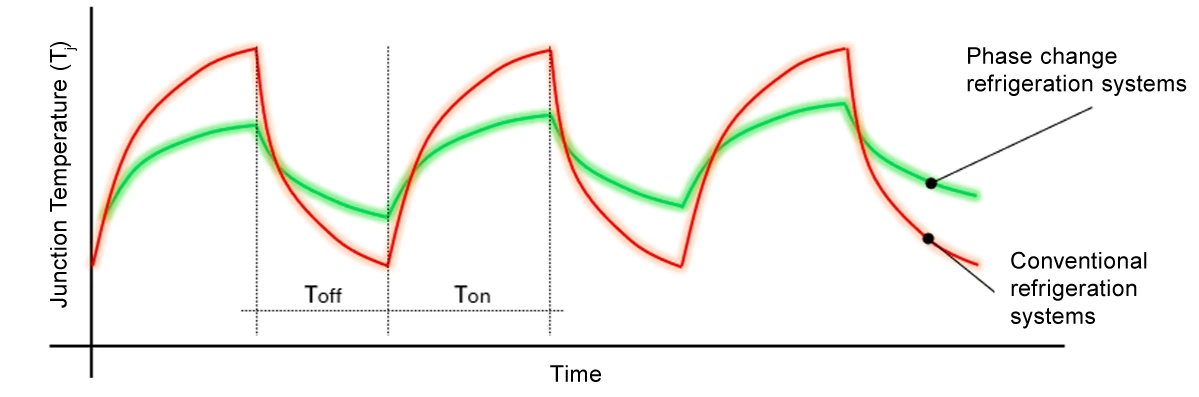
During switching, the semiconductor undergoes repeated cycles of conduction (Ton) and cutoff (Toff), resulting in continuous increases and decreases in junction temperature (Tj).
Conventional cooling systems dissipate the heat generated during conduction, preventing the maximum permissible junction temperature from being exceeded. However, when the device enters the cutoff phase (Toff), the system continues to dissipate heat at the same rate, causing a sharp drop in temperature.
This thermal ripple (continuous variation of Tj) is precisely what causes thermal fatigue in the metal bridges, accelerating their degradation and affecting the semiconductor’s reliability.
The advantage of phase change refrigeration
Compared to traditional methods, phase change cooling systems offer a more dynamic and stable thermal response.
During the conduction phase (Ton), the evaporation of the working fluid efficiently absorbs the generated heat, reducing the peak temperature. In the cutoff phase (Toff), as the heat flow decreases, evaporation also slows, preventing an excessive drop in temperature.
The result is a smaller amplitude of temperature fluctuations, which translates into:
Greater thermal stability of the junction.
Reduction of thermal fatigue in copper bridges.
Increased reliability and lifespan of the semiconductor.
ALAZ ARIMA: efficient and reliable thermal solutions
At ALAZ ARIMA, we develop passive cooling solutions based on phase change, specifically designed for high-performance power electronics components.
Our systems offer:
High thermal efficiency without the need for pumping.
Temperature stability even under variable operating conditions.
Greater reliability against thermal fatigue.
Maintenance-free and long lifespan.
This type of technology is ideal for applications such as photovoltaic inverters, wind turbine converters, Statcoms, UPSs and industrial converters, where reliability and thermal control are critical to ensure continuous and safe operation.
ALAZ ARIMA: Innovation in passive cooling for power electronics
At ALAZ ARIMA, we are committed to thermal innovation and the development of sustainable technologies that improve the performance and reliability of power electronics.
Our phase change cooling systems represent the natural evolution toward a more efficient, reliable and maintenance-free future.






Leave a Reply